What Piwi does
Playwright's HTML report is excellent, and it lasts exactly until the next build. Piwi keeps every run instead — every trace and report — and then does something with them: it groups the failures by root cause, scores the flaky tests by what they cost, and finds the locator you should have used. Self-hosted, MIT, zero telemetry.
Everything in the product is in service of three jobs, in this order. It's also the test for whether a feature belongs here at all: one that strengthens none of them is an argument against building it.
The three jobs
- Keep the history. CI deletes every report it makes. Piwi keeps every run, trace and report, so "has this always been flaky?" and "did my fix hold?" are answerable at all.
- Explain the failures. Group them by root cause so forty red tests become three problems, score the flaky ones by the CI minutes they actually waste, and — optionally — have an LLM explain a cluster against your real git diff.
- Hand back a fix. A ranked replacement locator, a validated patch, an owner, and the command that verifies the work. The point is to leave with something to do, not just something to read.
Everything else — analytics, notifications, the CI gate, PR feedback, the MCP server, the desktop app — is a delivery route for those three. The dashboard follows the same ranking: it leads with results and failures, and the supporting lenses sit behind them.
The loop it serves
Explaining a failure is the heart of it, and it's a loop: gather the evidence, group the failures by cause, explain why they broke, hand back a fix, then verify the fix actually held.
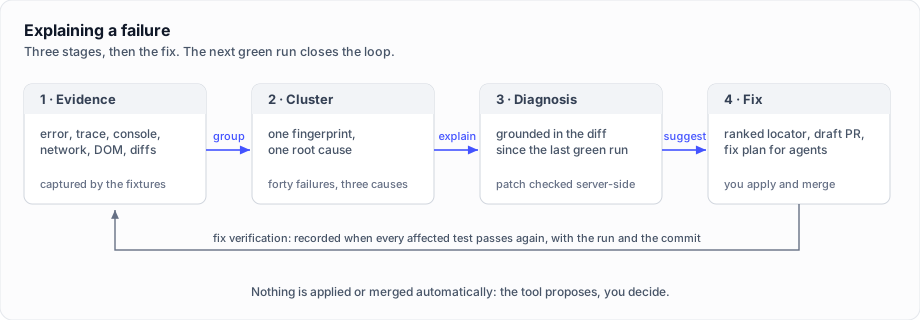
Each step is a page on this site: the failing execution and its evidence, failure clusters, AI diagnosis, locator healing and auto-heal PRs, and the fix verification that closes it.
Two rules
Two rules run through every feature, and they're worth knowing before you adopt it:
- The tool proposes, the developer decides. Piwi never rewrites a test, never merges a fix, and never applies a patch on its own. It gathers, ranks and suggests; the last step is always yours. Even auto-heal PRs only open a pull request for you to review and merge.
- Deterministic first, AI second. Anything that has to be right every time — clustering, flaky scoring, locator ranking, fix verification — is computed without a model. AI sits on top, where a suggestion is enough, and what it produces is checked against your real source before you see it. AI is off by default and brings your own key.
The pieces
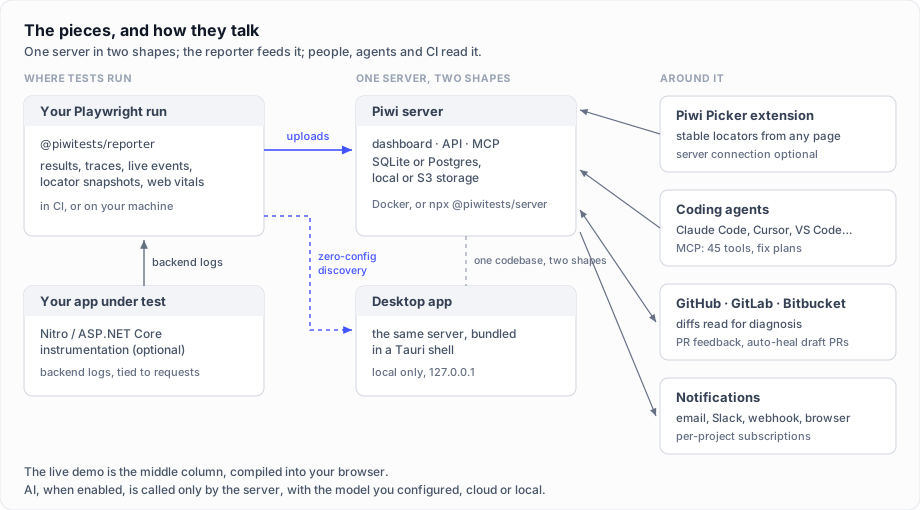
Piwi is a reporter that uploads from your Playwright run, a server (or the desktop app) that keeps and analyzes the results, and a set of ways to reach them — the browser extension, an MCP server and agent skills for coding agents, SCM providers for PR feedback and healing, and notifications.
What it isn't
Trust is the point, so the limits are stated plainly, not buried:
- Playwright only, by design. The ingest API, trace handling, step analytics and locator healing are all built around Playwright's model. If you need to aggregate many frameworks (JUnit, pytest, Cypress) into one place, ReportPortal or Allure fit better.
- Pre-1.0. Patch and minor releases can carry breaking changes, and the database schema moves with them — read Upgrading before you bump a tag.
- Not an "ask AI" button. Diagnosis is optional, grounded in your diff, and never in the write path.
Where to go next
- Getting started — pick a path and land your first run
- Core concepts — the vocabulary (run, execution, cluster, fingerprint, baseline)
- Why Piwi? (comparison & FAQ) — how it compares, and whether it's the right tool for you
- Live demo — the real app on seeded data, entirely in your browser